How Groton Handled the Spanish Flu
History teaches us many lessons, and those lessons can help us deal with current circumstances, particularly, the Covid-19 pandemic. In 1918, Groton confronted the Spanish Flu, a deadly virus that killed more than 50 million people and infected 500 million people, or one-third of the earth’s population then. According to school archives, the towns of...

How Groton Handled the Spanish Flu
Derek Hu '21, Editor in Chief|February 8, 2021
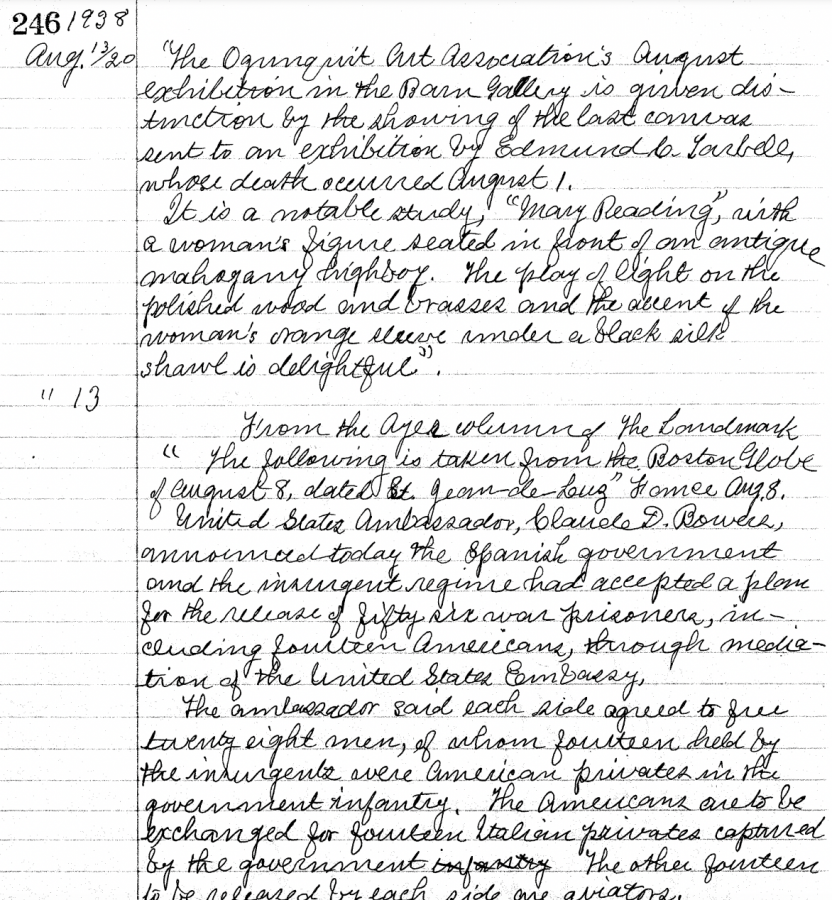
Primary source excerpt from Groton Town Diaries.
History teaches us many lessons, and those lessons can help us deal with current circumstances, particularly, the Covid-19 pandemic. In 1918, Groton confronted the Spanish Flu, a deadly virus that killed more than 50 million people and infected 500 million people, or one-third of the earth’s population then. According to school archives, the towns of Devens and Ayer, located only a few miles away from Groton, faced an alarming number of cases and fatalities. St. Mark’s School was also hit hard by the Spanish Flu, reporting sixty cases in total, and Camp Devens, a United States Army military installation located within the towns of Ayer and Shirley, recorded 15,000 cases.
Fortunately, though, Groton initially managed to avoid the Spanish Flu. Students returned to campus by September, just before the pandemic hit Camp Devens, and the school immediately placed strict quarantine measures into effect once the Spanish Flu started spreading in neighboring communities. In a Headmaster’s report in 1918, Endicott Peabody wrote, “During this last term the health of the boys has been exceptionally good.” Groton was completely shut off from the outside world, and students were not allowed to leave during Thanksgiving.
Similar to how Groton currently hosts various intramural sports, the school back then hosted intramural football games between Brooks House and Hundred House and between the Sixth Form and the rest of the school. Groton only participated in one interscholastic sporting event: losing 7-13 in a football match against Middlesex.
However, after Thanksgiving, Groton reported several cases of colds that were later accompanied by a fever. The school consulted Dr. Henry Jackson, a physician from Boston, and he believed that those cases arose from a mild form of influenza, not the Spanish Flu. By December 9th, 1918, the school dismissed all students, ten days before the date set for Christmas break. But by that time, students had already completed their exams, and the loss of schooling was to be made up for during the winter term.
Today, Groton uses a similar approach in that borders aren’t allowed to leave campus. However, with advances in medical science and technology, Groton doesn’t have to completely shut off its students and staff from the rest of the world. Zoom allows students to learn remotely. Weekly testing gives day students and staff members the opportunity to leave and enter campus. Mandatory mask wearing and strict social distancing measures reduce the chance of spread. But with the Spanish Flu taking place more than a century ago, Groton protected its students and teachers very well.
View Comments(1)

Groton Students’ Opinions on the Government Shutdown
“Pioneers and Architects”: Groton School Celebrates 50 Years of Co-Education
On the brisk Saturday morning of September 20, students, faculty, alumni, and former teachers gathered in the Campbell Performing Arts Center to celeb...
Tanzania GEO
“We had this realization that we live in a world with so many resources, yet we have a scarcity mindset as a culture. In Tanzania, if you just looke...
Groton Welcomes New Faculty to the Circle
This fall, Groton welcomes several new and returning faculty members to the Circle. Each brings their own set of experiences and enthusiasm to their r...
The History of Spirit Week
During this winter’s Spirit Week, dorms fiercely competed for the prize of a pizza feed with unique costumes and wild performances. From Girls Hoc...