A Case for the Senior Section
Four school days a week, the student body crams itself into the grand Gothic vault of St. John’s Chapel. As they enter, accompanied by the rich murmurs of Director of Choral Music Dan Moriarty’s organ playing, students swiftly regiment themselves into certain groupings. A similar pattern is observed in the Schoolhouse. Second Formers are relegated to the wellness hallway, Third Formers occupy the underbelly of the Forum, Fourth Formers mingle on the upper level of the Schoolhouse, and Fifth and Sixth Formers lounge self-assuredly in the Forum.
At first glance, this phenomenon seems backwards. Given Groton’s fervent commitment to inclusion and equality, why does such stratification exist? Is the presence of such divisions not polarizing? Do they not reek of entitlement?
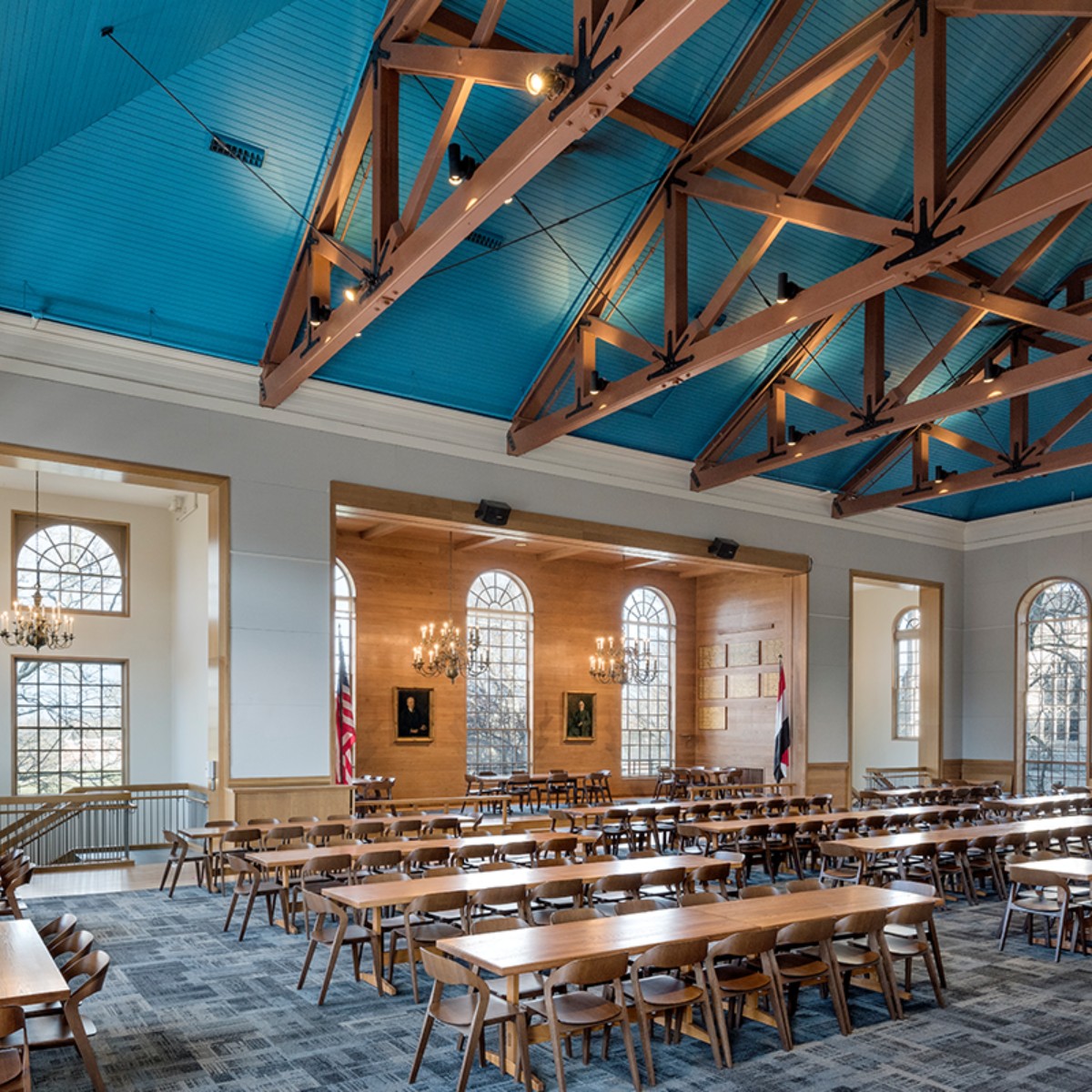
No. The sections at Groton do not stink of unearned privilege. The raised platform in the Dining Hall and the comfy couches of the library are not given to the Sixth Form arbitrarily. Status is not inherited at Groton. It is earned.
After all, Groton is not some run-of-the-mill high school. It is emotionally taxing, socially draining, and academically demanding. To have risen to the Sixth Form shows how one has navigated the Scylla and Charybdis of Groton’s rigors. Sixth Formers emerge resilient after years of being pummeled by work, overwhelmed by deadlines, and pushed beyond their physical limits. Sixth Form privileges serve only to recognize students’ perseverance throughout their time at Groton.
Alongside their role as tokens of industry, Groton’s spatial hierarchies also serve important aspirational purposes. When the Sixth Formers depart on Prize Day, the incoming senior class scrambles to establish themselves in formerly forbidden territory. Their readiness to ascend the ranks of the hierarchy speaks to a sort of aspirational quality that this hierarchy confers.
Characteristic of the Senior Section is its visual prominence. Sixth Formers dine on an elevated platform in the Dining Hall; their footsteps resound throughout the Chapel as they strut to the Senior Section, and they bask cozily in the library. On one hand, the conspicuous nature of these spaces reminds Sixth Formers of their responsibilities as leaders of the school. But they also become a source of admiration for younger students, who, with due diligence, may one day earn the privileges reserved for the senior class.
Senior privileges reinforce the meritocratic promise that actions drive achievements. Their gradual accrual of privileges is reflective of their hard work. Of course, this ethic has been enshrined in Groton’s academic, athletic, and artistic ethos, but the physical hierarchy makes this vision tangible.
The existence of exclusively senior sections seems perverse and counterproductive to Groton’s core mission and values. But such an objection lacks nuance. Homogenizing every aspect of social life in the name of equality is insular. After all, the outside world is strictly hierarchical in every regard. But by navigating the hierarchy of the Groton experience, we learn adaptability, self-assurance, and ease.