
Between Bloom and Burden: An Art Analysis of Sunday Gardening
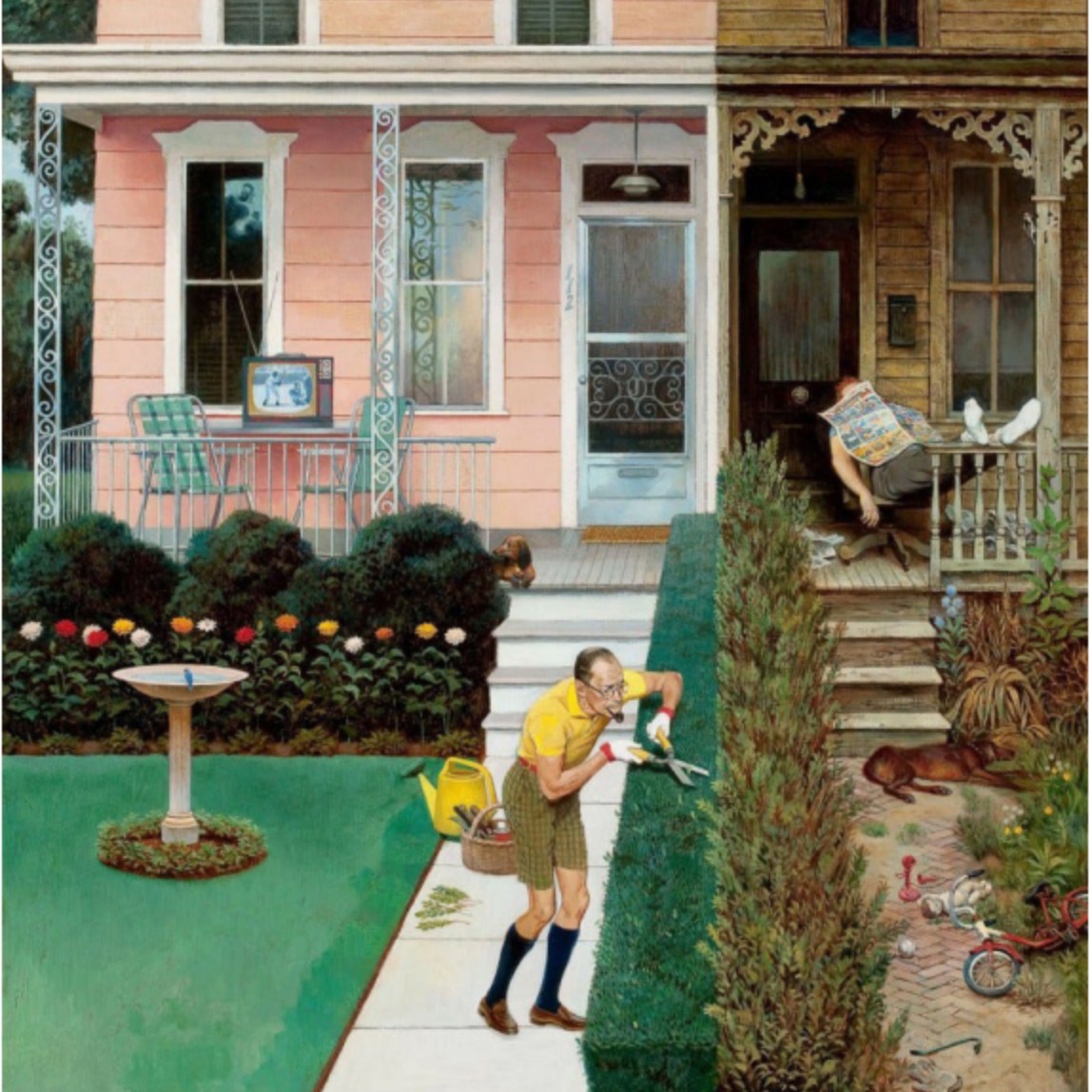
Sunday Gardening (1961) by John Falter depicts two houses that could not be more different, yet coexist in a single frame. The left side of the painting portrays planned growth—not a single blade of grass dares to be out of place. Flowers bloom perfectly upwards, framed by a spotlessly pink house, with an obedient dog as the cherry on top.
A man works furiously on the slightly overgrown hedge, his expression one of intense concentration as he trims off any imperfections. A bird perches delicately on the fountain, as if even nature lends itself to the manic perfectionism of the tweed-clad workaholic. The homeowner’s attire is yet another clue to his obsession with order. Though it is a Sunday, he wears polished brown loafers with long black socks, his hair slicked back neatly. These are not clothes worn to relax, but to work and to impress.
Whom he tries to impress, however, is another matter altogether. His focus is not on his neighbor nor a passerby, but on the task at hand. His organized lifestyle is not for show—he genuinely does it for himself. Yet, in doing so, he cannot indulge in the perfection he creates. The baseball game on the television goes unwatched, the spotless deck chairs unoccupied. He lives in a cycle of maintenance, unable even to pause and admire his work, never mind sit down and rest. The red belt matches the red on his gloves, and his shirt is the same yellow color as the watering pot, as if he is fundamentally tied to his work tools. On the pavement lie scraps of leaves from his neighbor’s hedge that grew past the rigid line of separation, illustrating his lack of tolerance for anything out of order, especially from the house next door.
The neighbor in question is fast asleep underneath a comic newspaper, with other newspapers scattered around him. His lawn, overgrown with weeds, is painted in tones of brown, hinting at decay and neglect. His dog naps as well, sprawled halfway across the path scattered with old children’s toys. On the dirtied wooden post, a woodpecker perches, drilling holes into the unpainted wood that no one will repair. The neighbor does not seem to care, relaxing peacefully out of sight. His side offers a stark contrast to that of the left: obsessive perfection versus carefree negligence.
The ratio of order to chaos is unequal; the tweed-clad man takes up more of the canvas, seemingly pushing his neighbor out of the frame. At Groton, we are more likely to be this tweed-man—the Circle rewards trimmed hedges and perfect upkeep. We spend more time walking around the Circle every day than we do playing on it. And though it would be easy to end here, telling you to be more like the resting neighbor, the man asleep under the comics is no better off. He is just as absent from the world.
Falter never captures the person who has this right. Both houses are occupied, but most importantly, the afternoon is not.
This painting represents an ironic comparison between two completely different lifestyles that hide some valuable advice for Grotonians. Be as meticulous as you want about schoolwork, sports, activities—but do not become so busy maintaining the term that you forget to be in it. The Arts Section wishes the Circle a wonderful beginning of the year, and hopes you are present in it. Hopefully, though, your rooms aren’t as messy as his lawn!