
How to Look at a Shattered Face: An Analysis of Bust of a Woman
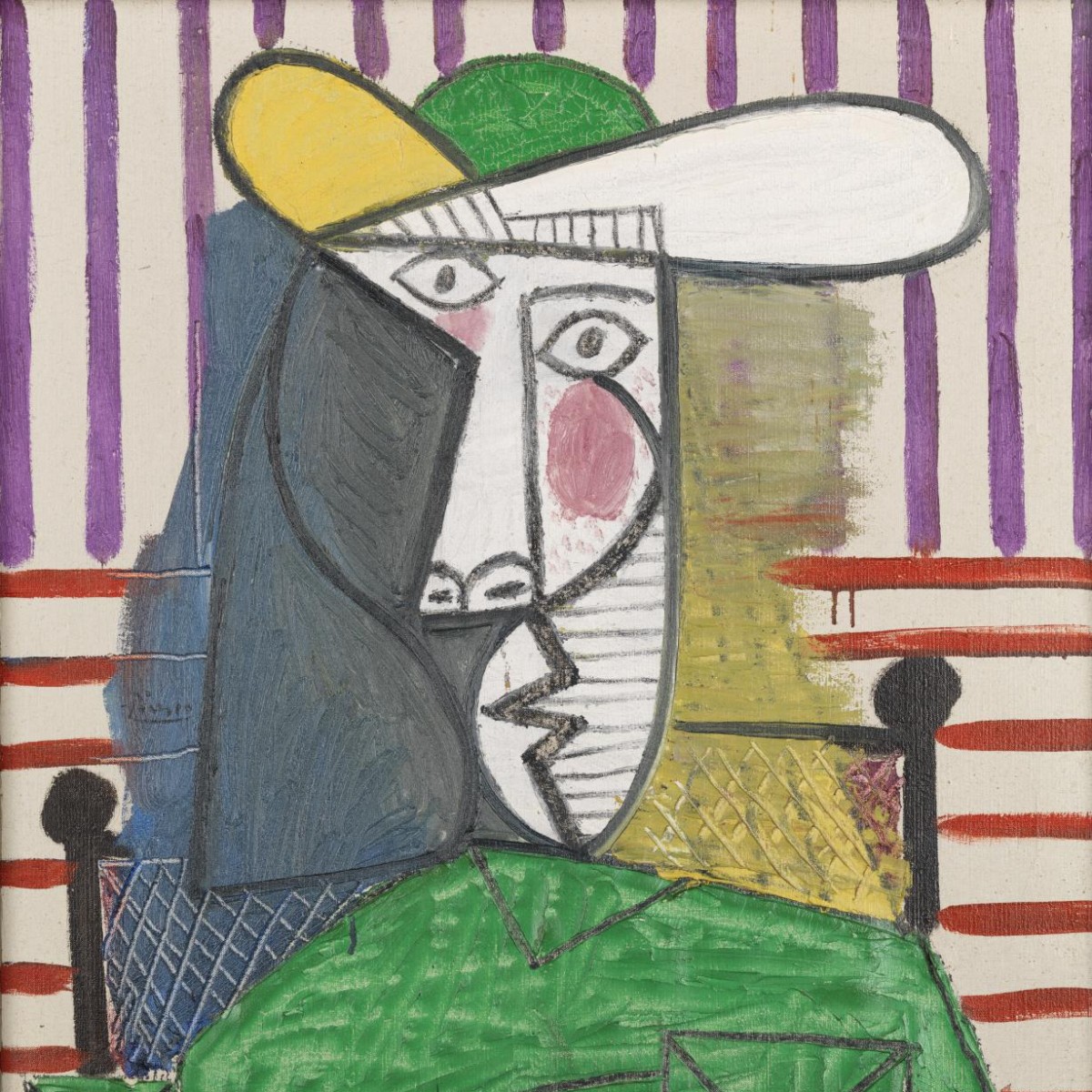
One would think they could easily understand a face. Two eyes, a nose, a mouth should be familiar territory, after all. In Pablo Picasso’s Bust Of a Woman (1944), however, the more closely we look, the more complex the face becomes.
At first, the woman appears emotionless. Her expression is staid, her posture controlled, and her face sculptural. Beyond these apparent details, familiarity withers away. Instead of forming a single expression, her features compete with each other. One eye faces us directly, the nose and mouth swing sharply to the side, and the other eye glances back across itself. They form conflicting angles that struggle to coexist within the same image: watching, circling, trying to make sense of one another. Against the dark background, the chaotic jumble of features on the puzzle of a face leaves the viewer unsure of where to look and what to make of it.
That uncertainty is what makes the portrait so striking. The painting prevents her identity from settling into one clear image, as if Picasso tried to fit several perspectives into one frame. Based on the angle or position of the observer, her face changes: one piece is larger, the other is sunken. The variance from the proportions and alignment we expect to see from a conventional face suggests not that the woman is impossible to see, but that the different parts of her are impossible to see all at once.
At Groton, this idea feels familiar. We often see one another in fragments: answering a question in class, warming up during practice, playing in a concert, or leading a meeting. From those fragments, it is easy to construct a complete picture. Someone seems confident and capable, so we assume that they must feel that way too.
In such an environment, composure can become a performance. The version of ourselves that is easiest for others to see may not be the full picture. We can appear to give a polished presentation in the morning, yet only we know the late-night revisions and the hours spent second-guessing the night before. Both versions can be real. Like Picasso’s portrait, they do not have to fit together neatly to belong to the same person.
Recognizing that gap between appearance and experience changes the way we read one another. It reminds us to leave room for uncertainty, and recognize the possibility that confidence and doubt, composure and confusion, can exist in us at once.
Bust of a Woman reminds us that seeing someone clearly is not the same as seeing them completely. As Parents Weekend brings families back to the Circle, they will be inclined to define our community and its students by their brightest, most eye-catching accomplishments. But like a mosaic, the fuller Groton picture takes its shape just as much from the quieter colors and smaller details: the uncertainty, effort, laughter, and everyday experiences that fill the spaces in between.