Interview with Christopher Landau
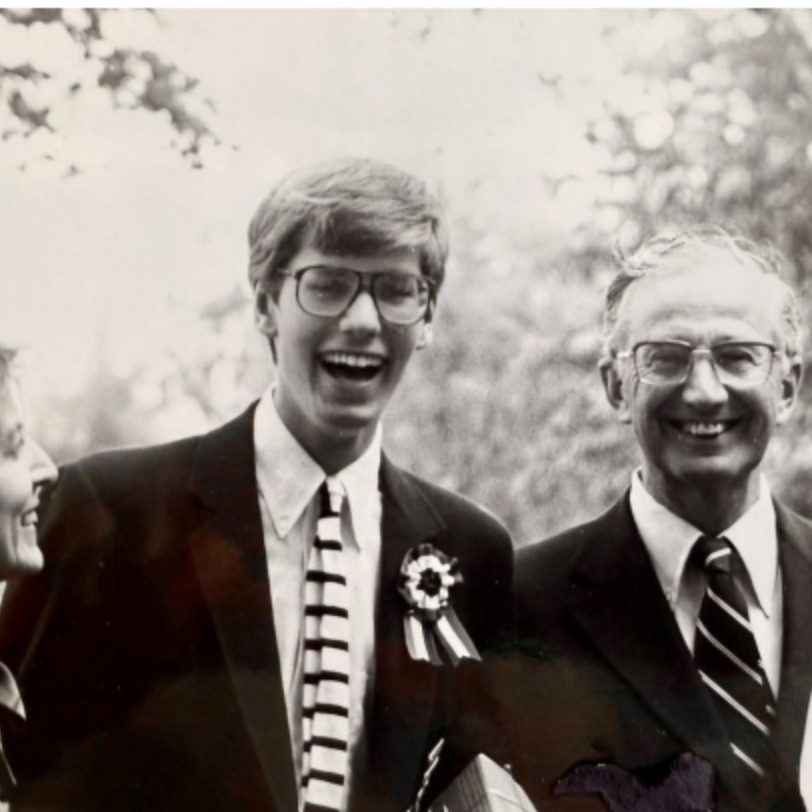
The Circle Voice interviewed the Deputy Secretary of State Christopher Landau ’81 P’25 on February 17, 2026. Below is an abridged version of the full interview text, which was sent in an email to Groton School students and faculty.
What does a day in your life look like?
I don't know. That's a great question. The Deputy Secretary of State position is a little bit like being the Vice President. It's a somewhat undefined job, and it really depends on the relationship between a particular Secretary of State and the Deputy, and different deputies organize it [in] different ways with different secretaries.
Secretary Rubio and I have not divided up the world geographically like some of our predecessors have done, so basically, my job is to pitch in for the Secretary and be his alter ego for things that he doesn't have the time to handle or can't go as deep into as I can.
I sometimes have meetings with visiting dignitaries. So let's say the foreign minister or vice foreign minister of another country is in town, I might have a meeting with him or her. Sometimes I meet with our ambassadors who are either leaving to go to another country or they're back in Washington for a reason, and I talk to them.
Sometimes I talk to the CEOs of important companies with a presence abroad, like today I had such a meeting with a company that has an issue in Mexico, and we talk[ed] through that issue and how we in the State Department might support them. I do a lot of this economic diplomacy.
How has Groton set you up for your career in law and now in the government?
I think it set me up beautifully in so many ways. I mean, I don't think I would be here but for my Groton education. I got such a terrific education there. I really learned how to write—so many of the courses I had [were] in history. I was always interested in history and geography, and we had some really great teachers in my day. I hope those kind[s] of teachers are still there. We had Mr. Dilworth, who was an incredible history teacher.
So I feel like it gave me just an amazing foundation for academic success in college and in law school, and then it was a natural progression from there to being a lawyer. I was an appellate litigator, so I did a lot of reading and writing: analytical thinking. But again, the ability to write well is such a powerful tool, and Groton really set me up for success on that. I'm very grateful to the School. Again, I don't think I'd be sitting here today if I hadn't received that excellent education.
On top of an intellectual foundation, did Groton also set up your moral foundation?
I do think the School was very good at character building, and I hope that hasn't gotten lost over the years.
I generally believe that a good deal is one that is good for both sides. And so I'm always looking for win-win situations in life. I think that's what gives the basis for lasting relationships and real wins. And I think Groton teaches you [this]. I feel that the time I was there (I graduated more than 45 years ago now). It provided a very solid foundation.
You can't really be successful without being a good person. That's a lesson I've tried to pass on to my children. I think character is king, and I really do believe that. I've always tried to abide by the great examples I had at Groton in terms of role models.
I still remember very vividly when I started [at Groton]. I had gone to school in Paraguay before that. My father was in the foreign service, and I was at the American School at Paraguay, and when the teacher would step out of a room during a test, everybody would just yell out the answers and throw papers up into the fan, and it was just a mess. Then, I went to Groton. I remember very vividly.
In biology in Third Form, the teacher just handed out the test and left the room, and I kind of looked around, everybody just was quietly doing their work. And that was a very powerful example of how you just obey the rules. And I think a lot of societies don't really have that, and so I learned to value that in our culture that people will do as they're expected to do, and you can hold people to a higher standard.
So again, I do think that there's both the intellectual formation, but then I think the character formation is at least as important that I should have mentioned [it] in the first part of my answer.
Has keeping these values been tough throughout your career?
I don't know, I don't think it's really been tough for me because I just take that for granted. I mean, that's just a part of who I am. So I don't really grapple with it. I don't ever think, gee, should I underhandedly undermine this person or that person. I just believe in fair treatment and being very transparent with what I'm doing. I don't have these moments, I guess, where I even contemplate doing anything else. I just think that has become part of who I am.
So, I don't—I just don't really believe in cheating. I guess I always just believe—and I tell this to my children: at the end of the day, I don't see how you could be successful in life if you can't look yourself in the mirror and say, “I'm proud to be this person,” right? I mean, if you have done it by cheating or unfairly, you, somehow, you—playing unfairly—then what's the point of winning under those circumstances? That just never has interested me.
So I just think that's become second nature to me. I like to think, I mean, again, I'm sure there are people who—I make mistakes, but I think I am certainly always trying my best. I'm a hard worker and I've always just been very, very forthright with people. I haven't really been tempted to do otherwise.
I really do believe honesty is the best policy, because I think it's [important] for people to know that you're a straight shooter. And even if you tell somebody something that they don't like, at least they respect you for telling it like it is. I mean, and that's something.
I just was in a foreign country, and I gave a message to a foreign leader that I don't think that leader was particularly happy to receive, but I think they respected the fact that I was very blunt about it. And he kind of laughed and said, “Well, you're not much of a diplomat.” I said, “Look, I'm just straight. I'm very frank.” And I think a lot of diplomacy is just about communication, and I think it's always good to be very straightforward and not play word games. And that's my brand, I guess. And I think it's always been that way since Groton—that I don't try to play little head games with people. I'm just very frank and straightforward and that has really worked for me.
I try and, again, people can say what I do is right or wrong, and obviously people can agree or disagree with the administration's policies, but I try to be very transparent about why I'm doing [it]. Again, I think that that's something that, in a democracy, we should insist on from all of our political leaders. So, it seems to me that should be a given. Sometimes, you have to make difficult judgment calls in these big government jobs, and, again, I'm always trying to do the right thing for the good of our country.
We (Liv and Jess) currently take Court and the Constitution, so we’re curious about your clerkships under Justices Scalia and Thomas. What is the most interesting piece of advice or moment you had with both of them?
Thank you for that question. I'm delighted that they have a course like that at Groton. They didn't have anything at all like that back in my day, and I think it would have been useful.
It was a real privilege after law school to get the opportunity to clerk at the Supreme Court and those are two justices I admire greatly because they had a very clear vision of the role of a judge under our system of separated powers—that it's not a judge's role to be a kind of philosopher king dispensing justice.
Real justice comes from abiding and neutrally and faithfully applying the law. A justice's job [is] to decide legal cases or controversies that come before him or her, come before the Supreme Court. People look at the results of the Supreme Court [and] say, "Well, the Supreme Court ruled this or that.” The Supreme Court is basically answering specific legal questions that come up, whether it be a constitutional challenge to a particular piece of legislation or resolving a particular dispute.
I think that words have meaning, and, again, a judge’s job is to put his or her own policy preferences [aside] to decide, and try to, very carefully, [parse the] language of a statute to make sure that the language Congress enacted into law is given effect.
We have very distinguished judges from Groton. Some of our esteemed Court of Appeals judges are from Groton. Greg Katsas ’82 was a year behind me at Groton, he was on the DC Circuit Court of Appeals here in Washington. And Steve Higginson ’79 was a couple years ahead of me, [he] is on the Fifth Circuit Court of Appeals in New Orleans.
I wish Groton would do more to bring back some of its distinguished federal judges to talk to you guys about some of these questions, because the law does a lot to shape who we are as a country, for better or for worse. And I wish when I was in your stage in life in Groton that I had gotten more exposure to that part of the world.
How would you describe Justice Scalia and Justice Thomas as people outside of their capacity in the legal world? What are they like? How was clerking for them like?
The courts in the '60s and '70s had kind of drifted much more into policy. They would be basically making decisions based on policy. Exactly what I said before, I think a judge should not do. Justice Scalia was one of the people who really helped bring [the courts] back towards their role of deciding controversies based on the language in front of them, whether that be a constitutional provision or a statute.
He was a very wise, very intellectual guy, but really a pleasure [to work with]. He would sit there with all the clerks, and we would go through all the cases, and it was a really intellectual interchange, which is obviously very intoxicating for somebody. I think I was 25 years old or 24 years old at the time, an incredible experience at that point in life.
Justice Thomas, I had a very close relationship with him. He's much closer in age to me. He's only 15 years older. So he was very young when he was appointed to the Supreme Court. He didn't have the extensive experience in the law that Justice Scalia had, but he's a very principled thinker. He came in with a very clear view about what the role of a judge is in a democratic society and very much the same worldview as Justice Scalia in terms of the role of a judge, trying to be faithful to the language of the statute or the Constitution. Both of these justices, I think, will have had quite an impact on American law by the time all is said and done, and both of them have my total loyalty.
When you look at a map of the world—you're doing all this traveling—what comes to mind? What brings you optimism, and what worries you?
A big priority is highlighting the importance of our economic and commercial relationships, so that our foreign policy actually brings tangible material benefits to the American people, that we create opportunities, economic opportunities abroad, either creating new export markets for American companies or creating investment opportunities for American companies abroad or promoting direct investment by foreigners in the United States. I get very excited about these kinds of economic issues that I think have played too small a role in our foreign policy in recent years.
I'm also very focused on issues of migration, which are going to be massive issues in this century. We've seen some truly earth-shaking migratory patterns over the last 20, 30 years, of different migration flows from one part of the world to another, and that's going to be a critical foreign policy component of the century as we think through the migration consequences of our policies.
Then I'm always looking to shine a spotlight on parts of the world that just have not received the attention that they deserve. I'll mention three: one that is highlighted in our national security strategy from last year is the Western Hemisphere.
I grew up in the Western Hemisphere. As I mentioned, my father was a career foreign service officer. When I was at Groton, my father was ambassador to Chile for about five years when I was in high school and college. I think that Americans have traditionally looked to Europe primarily for foreign policy. I think there's probably no other country in the world that affects our own security [and] prosperity more than Mexico. So I'm very interested in Latin America. We've made that a big priority.
I'm also very interested in the Pacific Islands, where I'll be going later this week. If you look at their exclusive economic zones, they're very strategic in terms of their presence in the Pacific Ocean.
And third, [I’m] very interested in the former Soviet Republics of Central Asia. Last year, I went to Kazakhstan and Uzbekistan, and I think there's a lot of both human resources and natural resources countries—great markets for American products.
I haven't even mentioned Africa. I just got back from a trip to Africa and Africa's going to go from about 18% of the world population to around 42% by the end of the century. It's going to rival Asia for its share of the world's population. So you can only imagine how that's going to grow, and I think that's going to be one of the huge challenges for the century, for your generation, how to make sure that Africa's incredible economic and incredible demographic growth is matched with economic opportunities to prevent it becoming a real center of instability in the world.
What should Groton students do if they want to pursue a career in foreign policy? What sort of majors, what should they do in college and in graduate school? What should they look into?
If you are interested in foreign affairs, I would just encourage you to keep up on news from around the world. I mean, I used to read the newspapers religiously. I'd go to the library, and I would read all the foreign news. There's no substitute [for] just learning about the world. It's really a question of curiosity.
Particularly in high school, your attention span is usually about 25 feet from your navel, and I would encourage you to think more broadly about questions of public policy and world affairs. I hope the School would sometimes have speakers who would bring up world affairs topics where students can ask questions. We used to do that in my day.
I majored in History in college. I think that that is a very valuable degree to just learn a lot about other countries' histories. I feel like that background prepared me very well for this job. In fact, I took a course Sixth Form year in American diplomacy. I don't suspect that course exists anymore. But, I still have my textbook from that course. I graduated class of '81, and that textbook is dated “Chris Landau, September 12th, 1980,” because I used it fall Sixth Form year. It's interesting to go back to that diplomatic history textbook and just read what I learned.
I still have my underlinings in that book. That book is right down the hallway in my office as Deputy Secretary of State. It's the same book I used in the Schoolhouse that I carried around in my backpack back in 1980 and 1981. I had a great foundation that I still draw upon. The other day I wanted to know exactly the language of the Monroe Doctrine, and what book did I open? It was that school book from Groton.
I remember when I was a senior in college, I went down to Venezuela where my dad was an ambassador and said, "I want to take the foreign service exam." And he said, "Why don't you go to law school? And that way, you'll always have a professional degree and a career to fall back on. I thought that was good advice, and I took it, and I went to law school, and then I clerked, and I just went on a path, and I practiced law for 25 years.
Groton positioned me very well by really giving me the tools I needed to succeed in reading and writing, which are so important as a lawyer. But then again I was very blessed. I'd always wanted to pivot back to foreign policy, and I had the opportunity to go as ambassador to Mexico. I speak Spanish from my childhood, and I took Spanish at Groton, and I took French at Groton. In fact, I sometimes have meetings with foreign leaders that I actually conduct in French, because at least I still understand French from AP French from Groton. So, there are many ways in which I still draw on that.
There's many ways to make it work. But again, I think a solid grounding in history and always reading up on international affairs is probably the best you can do.
Listen, I admire you guys. The Circle Voice is an important thing. I am grateful to Groton. I was very happy when you asked me if you could interview me. I still look up at the names in the Chapel there. You see Dean Acheson, former Secretary of State, Franklin Roosevelt, the President. Sumner Welles, who had my job as the Deputy Secretary [which] was then called the Undersecretary of State, is a distinguished Grotonian.
I am going in the footsteps of a lot of predecessors from a long time ago, and it gives me great pleasure to continue that long and distinguished trajectory, and I look forward to somebody from among you, somebody who's in the School now, sitting in my office in the State Department in another 40 years, and reflecting on this conversation—maybe, as something that gave you a kick in the butt to pursue these interests.