
The Echo of an Unlived Life: Sirens in The Odyssey
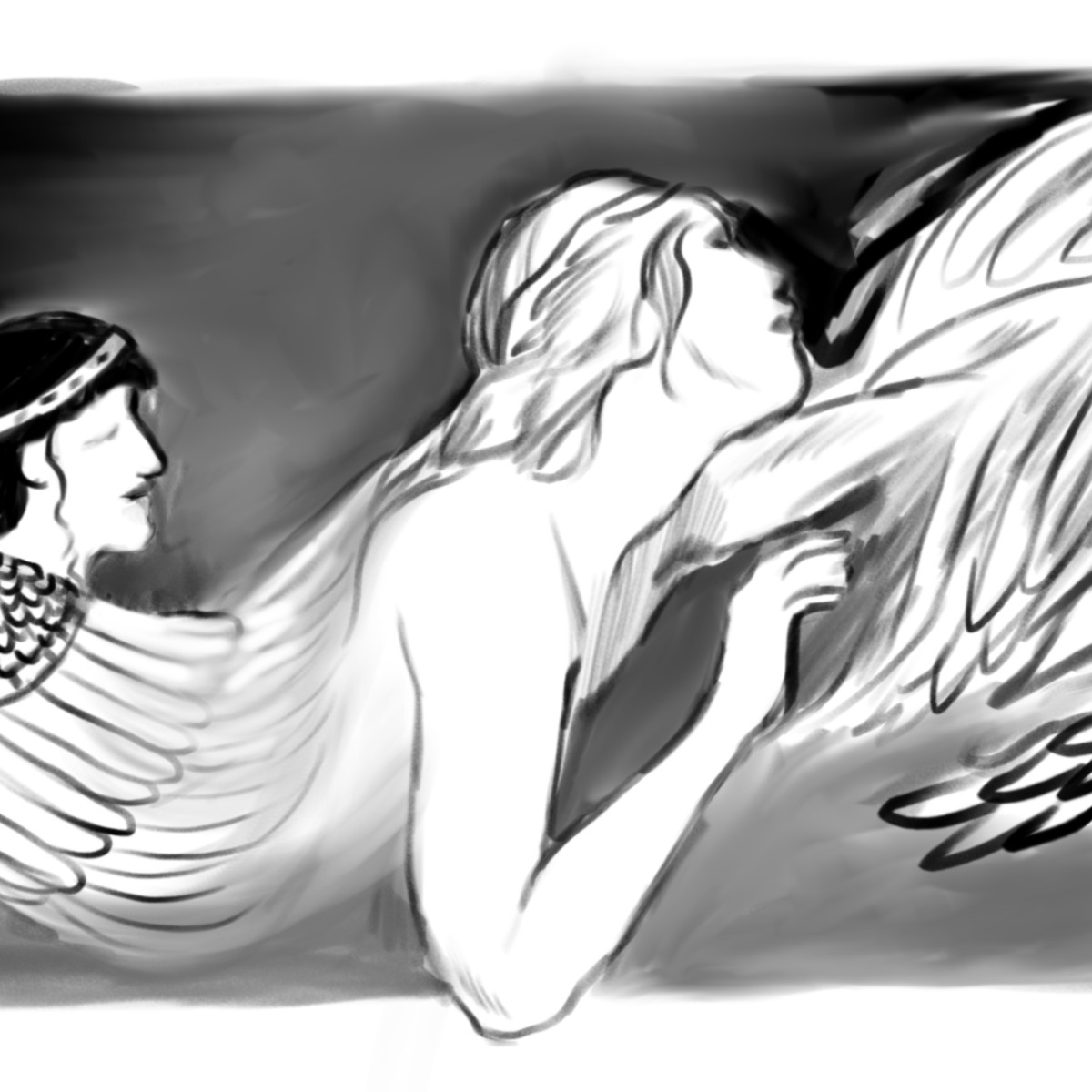
This summer, when Christopher Nolan’s Odysseus finally describes the Sirens’ song in his new film adaptation of The Odyssey, he does not speak of music. Odysseus speaks of everything he desired, lost, and failed to become. It is an unusual answer for one of the epic’s most familiar episodes. But perhaps the Sirens have always changed based on what their listeners fear most—a shift visible across 25 centuries of art, from an ancient Greek vase to a Hollywood soundstage.
On an Attic red-figure vase from around 480 BCE, the Sirens are far from seductive. Human-headed and bird-bodied, they perch around Odysseus’s ship as creatures of another order. Odysseus alone is bound to the mast, his head tilted back toward them, while his crew rows steadily on. The composition renders his predicament almost like a test: everyone else can simply block out the song, but Odysseus chooses to listen. In Homer, they promise knowledge of Troy and of all that happens on earth. In this ancient image, threat lies not in desire for the Sirens, but in the more unsettling urge to know beyond what is safe.
By Herbert James Draper’s Ulysses and the Sirens (1909), that threat has assumed a different form. Draper fills the foreground with pale, graceful bodies climbing over Odysseus’s ship. Their wings and tails remain, but almost as decorative remnants—what commands attention first is their beauty. Homer never tells us that the Sirens are beautiful, yet Draper’s painting makes their appearance inseparable from their power. The change reflects a nineteenth-century fascination with the femme fatale: female sexuality imagined as irresistible precisely because it is a danger men wanted not just to survive, but to conquer. What the ancient Sirens know has receded behind what these Sirens awaken.
Pavlina Vagioni’s Sirens series, painted in 2021 and 2022, shifts the source of that danger once more. The birdlike figure returns, but fragmented and abstracted into recurring wings that seem to multiply across the canvas. Vagioni connects her Sirens to consciousness, ego and the mind’s capacity for self-entrapment. The return to the ancient bird is thus not a return to the past. The monster no longer waits on an island, calling to the traveler. It circles within the mind itself.
Across these images, the source of danger relocates: from knowledge, to desire, to consciousness. The Sirens reveal how thoroughly art can reshape the myths we inherit, preserving the same story while changing what, within it, seems most threatening.
Perhaps Nolan’s Odysseus belongs to this tradition. His Sirens seem to understand not the world, but the listener: his longings, regrets, and the life he might have lived. In an age preoccupied with identity and self-examination, temptation is no longer simply something that lures us from outside; it lies in the relentless comparison between who we are and who we might have been. Vagioni’s circling wings and Nolan’s song arrive, in different forms, at the same unsettling truth: the most inescapable voice is one’s own. Every age, perhaps, hears something different in the Sirens’ song. Ours hears the echo of an unlived life.