
The Midterms and Political Engagement on the Circle
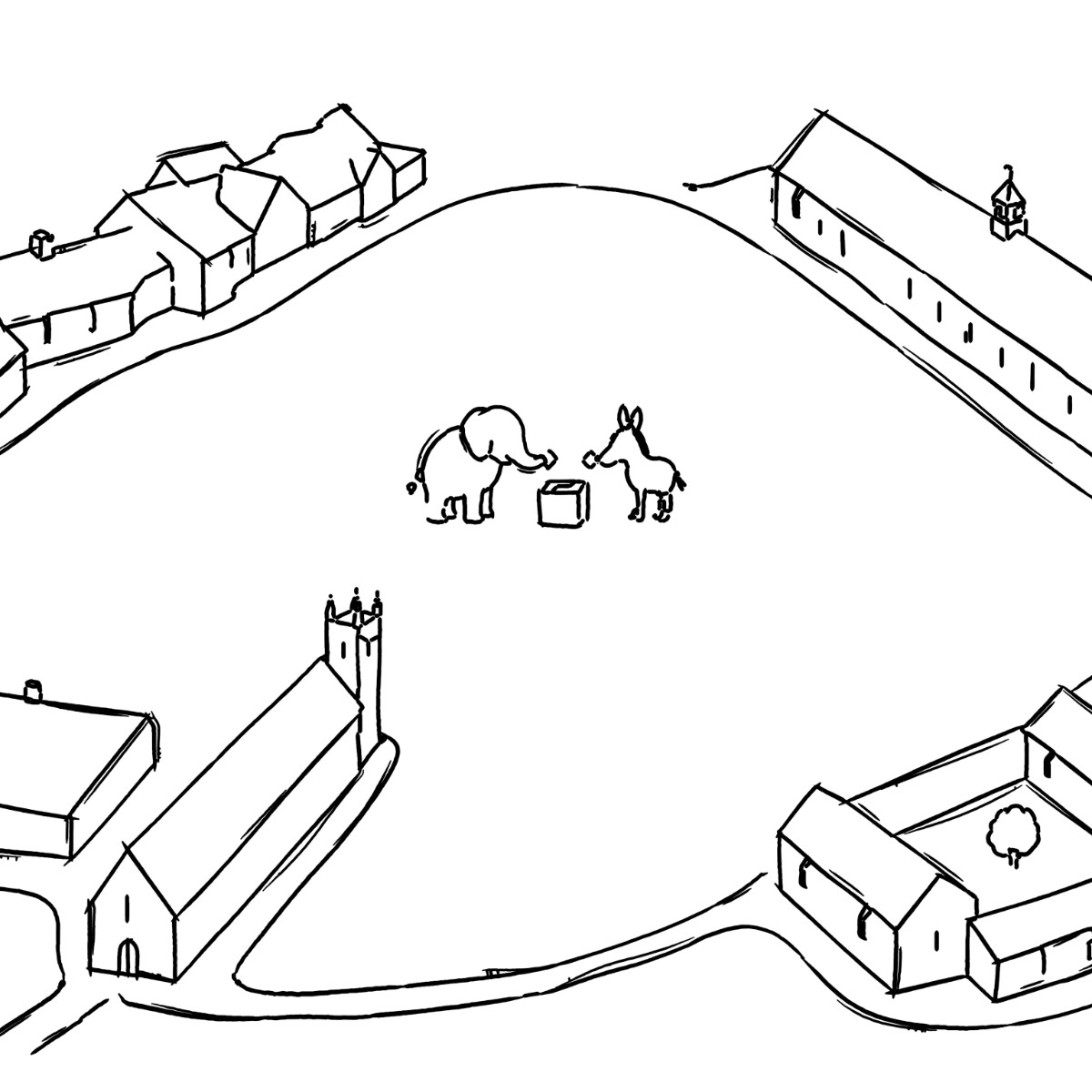
The 2028 United States midterm election cycle holds a special significance for both Groton and the country as a whole.
More than 94 percent of the Groton students who responded to The Circle Voice’s 2026 State of the Circle survey do not support the actions of our current administration. With 10.5 percent of students identifying themselves as Republican, these statistics taken together show that at least half of the Republican students don’t support the actions of their own party.
Groton students over the age of 18 will vote either at the polls or via mail in ballots to their home state. However, even for those below the voting age, the effects of the election cycle are still being felt across campus.
“It can feel like politics doesn’t really affect us too much, but I think that for everybody they do to a certain extent,” notes Young Democrats Head Will Turvey ’28.
With the midterms just around the corner, Groton’s student political societies are coming together to foster discourse and combat division. We interviewed heads of both the Young Democrats and Young Republicans to see how they are thinking about the midterms and working to create safe spaces for discussion on the Circle.
“This election cycle is particularly important because of how tight the house and senate are, I think both are susceptible to flipping, ” said Young Democrats Head Nikhil Luthra ’27 when questioned on the importance of this upcoming midterm election.
Tight senate races in historically Republican or Democrat states, in addition to the presidential midterm, have been topics of discussion in recent meetings.
Heads are also using the platform of Groton’s political societies to spread awareness on the values and evolving stances of their respective parties.
“The Republican party is not the party of Donald Trump and that’s an important distinction to make,” said Young Republicans Head Andrew Wetenhall ’28.
The Republican Party, along with the Young Reps at Groton, are reckoning with what their party and its values represent in this current political climate. Andrew describes the party as “the workers’ party, the party of keeping your wages, the party of working hard,” but acknowledges that “being Republican is conflated with MAGA.”
The midterms give all students an opportunity to deeply explore and reflect on their own political and personal beliefs. Therefore, giving students at Groton room to learn and talk about current events in the U.S. government is essential, done with the goal of allowing them to expand their knowledge.
“I encourage people to do their own research and learn more about what they're interested in,” said Young Republicans Head Ettore Monson ’27.
Both Young Republicans and Young Democrats acknowledge that discourse between two polarized parties is crucial in cultivating a more unified and understanding community on the Circle.
“We have been talking [with Young Democrat heads] and trying to bring the groups together to educate the campus more,” said Andrew.
Young Republicans have met twice so far this year, and Young Democrats have met three times, with plans for a joint meeting soon. Both groups emphasize that students of all political affiliations are welcome at meetings, creating a space for students of different backgrounds and beliefs to engage with each other.
“I was in a conversation recently where I found myself agreeing on a few certain points which one of the Young Republicans had, which I found really interesting,” said Nikhil. “The goal as a community is if we can navigate that tension and look at the nuance we can find ourselves common ground.”
Finding similarities among differences in politics and in our community is imperative if we are to maintain a curious and nonjudgemental culture around Groton politics, and the midterms are an opportunity for students, with the help of student-led political organizations, to create spaces where that can happen.